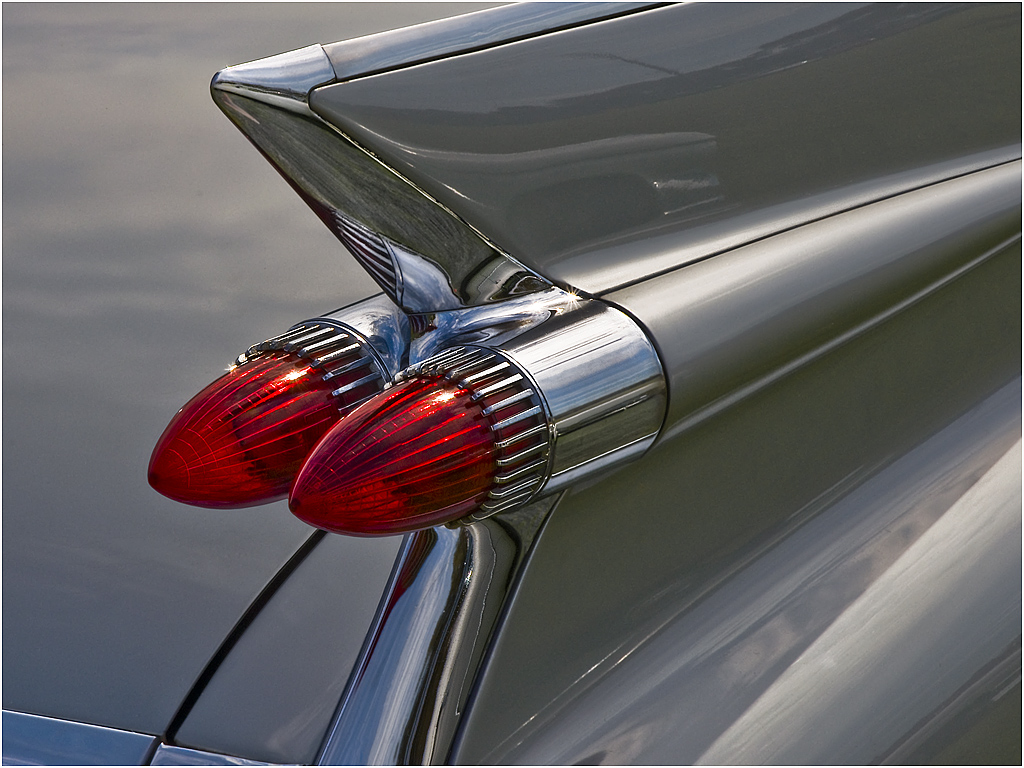
Another competition night. This time we had non-SAPF judge Lindsay Poland from City Cross Camera House judging the Detail competition. Lindsay surveyed our work, and although he’s often happy to share opinions (wander in to the shop and have a chat :lol:) he was a bit less fulsome in his comments on this evening.
That worked to our advantage as he quickly judged the images, with some minor critical comments, and as always reserved the highest marks for the absolute best images (no one got a 10!).
But what we did afterward I think added to the night significantly – I asked him why he awarded the images the marks he did – from the low to the high. For example, Jenny Pedlar’s blue door was a great image and he really liked it, but he down graded it a bit due to some distracting elements in one corner. There was a bird print from James that got a lowish mark – the reason was due to what appeared to Lindsay to be over sharpening. A high key image of my daughters eye was down graded as he felt it needed some more of her face (not just her eye) – to make it more of a story than a clinical image (fair comment). This sort of Q&A generated some interesting discussion from the floor which went on for another 20 minutes and I feel was more productive for many of us as it was a conversation between us and the judge rather than wisdom from upon high.
So if you are all willing, we might try this with some other judges as the year progresses and tease out far more than the thinking out loud we are used to hearing. In the meantime, check out the top digital images (sorry – haven’t had time to get the top prints from authors)
Workshops have been a touch tricky this year – our guest speakers or events haven’t always worked out or been available, and this evening looked like being the same! The night was supposed to be about Antarctica, but we had to find a guest speaker at very short notice.
His work takes him away from home for 3-4 months – usually to the bush
Jeremy runs education sessions for ArtsSA at Carclew, and for SA Health. The workshops are very much participatory events and often involve mental health, disadvantaged groups or juvenile detention kids – the main point being to engage people. This can be used to advantage in school setting too with team building exercises.
In all cases, strong outcomes are sought, bombarding the participant with creative, high energy material – homework is optional!
If you’ve been to the Royal Show you may have an Ikea catalogue – with your picture on the cover. That was Jeremy’s job (very hard work!!!), but he also runs a lot of pop up photo sessions for people like SANTOS or the Motor Accident Commission
There isn’t a lot of marketing in his other work, which these days is mainly digital and straddles both commercial contracts and visual arts.
He has some exhibitions too – cafes, pubs, restaurants if your interested.
So as you can see, he has a lot to occupy him and tries to have a range of jobs that keep him occupied for a good part of the year. Have a look at what Jeremy is working on at present and you get the idea:
A youth workshop at Streaky Bay for 12-25 year olds with a fashion stylist
a 20 year retrospective of his work
Pop up photo booths for Schoolies
a new portrait folio
a book for a church
feet for a beautician
Red Cross Drug and Alcohol programme
the migration team to help refugees
a project with children in Sri Lanka
We got onto some general discussions like Why do we take photos? The answers that popped up from the audience ranged through capturing beauty, autobiographical, needing an audience (don’t we all?), sharing (yep!), getting new ideas and discussing photos. Now aren’t they the reasons that a lot of us are members of Blackwood Photographic Club?
Jeremy suggested if we want to extend ourselves try setting an assignment – find “faces”, shoot colour, take candid shots. We had a bit of general discussion about candid photos. Jeremy found that people in Australia aren’t as shy about having their photos taken as we think. He showed some images he’d taken in New York (he’s been there and used a point and shoot rather than dSLR to really get involved) and said Adelaide wasn’t really that much different.
If we are to take photos be aware of some of the rules. There is no actual right to privacy although we have a reasonable expectation of it. The important distinction is that if peoples images are used commercially (ie for profit/sale) that’s a possible risk of litigation if they have not consented. On the other hand, places like the beach are public places, as are city streets and there is no law restricting photography per se. Be overt about taking your photos, don’t be timid, and even share the photos with the subjects. However, there are restrictions regarding children, private property, Defense department land, Sydney Harbour Bridge foreshore and others. There is a discussion going on around the world about this, and situations where people try to forbid you to take pictures (eg security guards) may not be a problem after all – but check the situation. Have a look at the 4020 and Arts Law web sites for more information – there is quite a bit about it.
Jeremy then asked if we’d do a questionnaire to help him frame workshops for groups such as ours – and talked about getting the most out of your images as we answered his questions. Things like:
understanding your camera
photograph what you love
change your white balance
use different view of your subject (low/high/left/right/above/below etc)
shoot to a brief to test yourself
Shoot wide angle
use Photoshop to try tilt & shift for correcting architecture
The discussion moved on to some images that Jeremy brought in of his work – ranging from product shots, to portraits, multiple prints on one sheet (that reduces cost), adding grain to images (gives it that film feel) and some tasteful human form studies in various environments. He noted that digital photography has affected professional business (as everyone’s a photographer now!) and this is now reduced, and so value has dropped. Interestingly, darkroom prints have become more valuable.
So after a wide ranging discussion, Jeremy went away with his questionnaire, and we went away with some ideas about what professional do and how they survive in a cut throat world.
Oh – and before I forget, welcome to new member Peter (who’s also in Edwardstown – but we won’t hold that against him :lol:)
For those that missed it, Jeremy has organised a portrait workshop (at a cost of course) – which filled quickly – and 8 of us will be taking part. Others will occur if there is sufficient demand.
Another competition to try out our skills and test the judge! A cold, wet night had a good gathering present to compete and enjoy some fine images. We also had two visitors – Antoinette & Howard and two former visitors decided they liked what they saw – welcome to Chris and Peter. Hope you get involved in the workshops and competitions soon!
On the subject of judging, when you get a chance have a read of James Allan’s piece on St Peter in the latest Camera Clips – it will make you think about what the judge has to do.
Before I get into the evenings competition, a few house keeping items:
7-Jun-2012: Will now be Jeremy Watson (of the Natural light portraits evening!) talking about his work and what people would like at workshops
17-Jul-2012: Edwardstown interclub – get your images organised soon. We will want final image names at least 1 week before the event
2-Aug-2012: Now the AV night with John Hodgson
30-Aug-2012: Now the Antarctica talk (and possible Astrophotography too!)
Outings
We are working on a Queen’s Birthday outing – I’ll send out an email with the plan, but if your free on the Monday we should have something for you. If not, James Allan will be in Whyalla swimming with the Giant Cuttlefish and your invited to join him.
We are also finalising the October Long Weekend outing – more soon.
Exhibitions
The SAPF Annual Exhibition Venue: United Eastern Association Masonic Complex
1 Fisher Street , Tusmore, SA, 5065 Exhibition Dates:
Saturday 14th July 2012, 12.00 noon through to the Official Opening at 7.30pm
Sunday 15th July, 11.00 am – 5.00 pmWe have now sent off the images to the SAPF exhibition. The club aims to exhibit an images from each member who submits an image (we are limited to 2 by the rules), but we are only allowed to exhibit 10 images in total. We were actually oversubscribed on this occasion, with more exhibitors (and images) than we were allowed, so we had to choose the best of each potential exhibitor, and then reduce that to 10 out of that group. Selection was based on a vote by the 9 committee members present.
Our apologies to those that missed out on this occasion – all of you were in there, and only missed out by small margins
After a careful evaluation of the images submitted, we selected 10 different club members – and will also post them here later.
Lindsay Poland and 11 other professionals will be exhibiting at SALA this year as Skrambled Eggs. We’re all invited to have a look and see what the pros do when they aren’t shooting for a client. They’re web site shows previous years – and it looks quite good. More details when I have them.
Now on to our competition – the theme was Seen Better Days – a chance to photograph those old, decaying objects and show how interesting they could be. Tonight it was immediate past President of the SAPF – Peter Phillips – judging our work. As Peter pointed out, the opinions he gave were his own – although the author might feel they were unfairly scored it was only an opinion on the night. Even Peter had experienced images that scored 7 when he was sure they were worth a 10! Peter pointed he judged more on impact than technical aspects, and his comments reflected that – once again good critique of the art of the image (one of those things we like!) with less focus on the technical rules. After the competition, he commented that the standard of the club images was very high – probably better than his last visit, and some great work was being displayed.
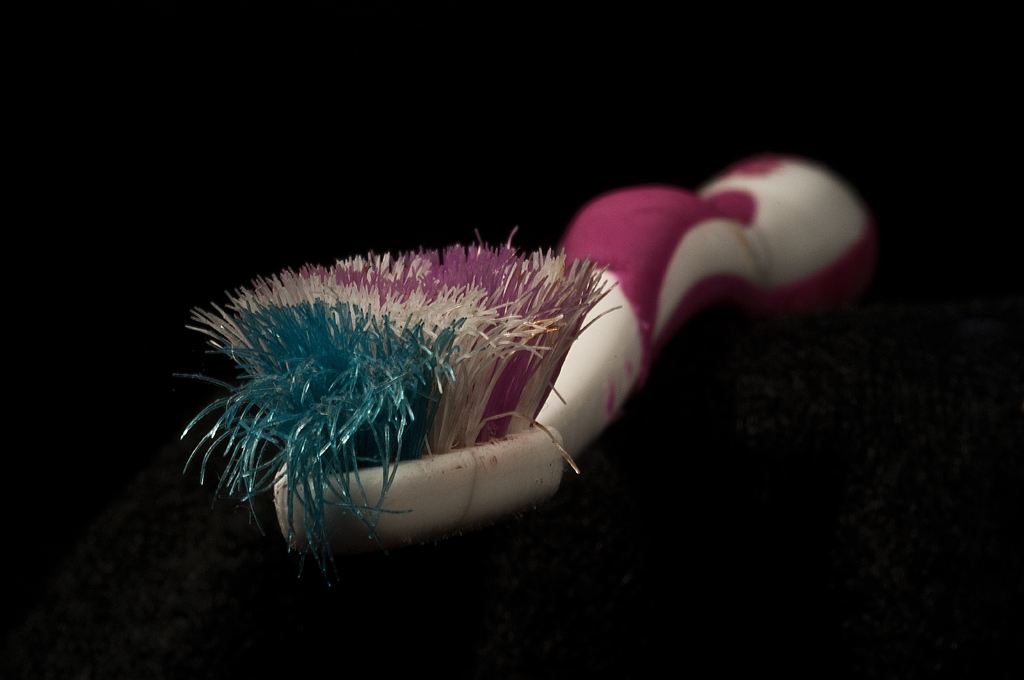
We had 120 images for Peter to judge (including Eric’s used toothbrush above – is that a Colgate or an Oral-B?) – mainly prints on this occasion, with 38 projected images (9 slides!). The range of images was fascinating with rusty cars, aged doors, worn toothbrushes, a dead bird, decaying houses, lots of the 12 Apostles (on the Great Ocean Road), encrusted ovens and broken pipes. That these things are around us constantly and we don’t really notice them is an interesting discussion in it own right.What struck me was the diversity of decaying objects. As Arthur pointed out in his talk a few weeks ago, decaying objects make fascinating compositions – not just photographs. Well done everyone!
Head over to the Top Print and Digital pages to see what did well, and a few more.
The theme for tonight was a presentation by 3 club members about their photographic passion. When planning the evening we decide to encompass different areas of photography – slides, image manipulation and something we rarely see – underwater photography. We also had a few visitors this evening – Trevor from Noarlunga Club, Peter on his second visit, and Audrey – acting as Arthur’s driver.
Thankfully (thankyou Audrey), our slide expert Arthur Farmer was able to attend, despite his difficulty with travel at the moment – and it was worth the effort.
As Arthur pointed out, slides have a two of useful advantages – they have longevity and are quite easy to store.
In his work, he now uses Velvia and also creates his amazing black & white slides with normal black & white film, then sends it to the US for processing into a slide. We were told about a passion for studying decay (odd for a surgeon), which produces some fascinating composition which lends itself to both colour and B&W. He has found that simple structures & textures lead the eye. Also utilising low light (early and late in the day) and getting in close to create a composition means that its not just a photograph of the subject – an important point.
In many respects, this philosophy is inspired by the great artists such as Heysen and Titian, who used out of focus areas to draw the eye to the focus of the image. Whatever the inspiration, we can always be assured that Arthur will produce images that make us think!
Our next speaker was Eric Budworth who told us how, as a film spooler in London, he was bitten by the bug – although he was also a train spotter!
In 1958 he bought his first camera at the Brussells World Fair. Then in Spain, he bought a Voigtlander camera with a 50mm f2.8 lens. He later sold it, but got it back when the purchaser said it didn’t work – it just needed some film.
Eric also entered the digital world early, with a Nikon D1 – a 2.7Mpixel camera that produces some great images. Though it was a bit large, it had the advantage of a 1/6000s shutter speed and access to great glass. He still uses a Nikon digital, but points out that he stores his old slides digitally by photographing them – just need a bellows and a slide holder.
Photographically, Eric like to play around – no special subject for him – although he does like still life. He enjoys the way digital lets him manipulate things, and subscribes to the UK magazine “Digital Photography” from which he gets many ideas and tries them out. The advantage of this magazine he finds is the clear step by step explanations provided.
Eric is inspired by things around him as well, getting ideas from the magazines and trying them out. He gave many examples of how he took the images displayed in the video at above, including bolting a camera and flash in his car whilst driving, how he created the image of the jigsaw using a template and perspective translation tool in photoshop, and the penwash of the two prints – turning a fairly uninspiring image into something special as I’m sure you’ll agree.
The final set of images are a template Eric obtained to create calendars to share with his friends overseas – a pretty impressive set of images.
Personally, I find Eric produces many great images that challenge us (and the judges) – and coupled with his ever present wit is an inspiration to try new things.
The final speaker for the evening was Richard Wormald. Unknown to many of us, Richard is both a keen photographer and a diver. He has coupled these two hobbies into one – although he admits his diving is less freqent than it used to be. He even spent time as a diving instructor with the motto “no conditions were too bad!“ . His inspiration for diving came from the TV program Sea Hunt (does that show his age?) – you can see the similarity between Richard and Lloyd Bridges can’t you? By the way, I had to rope him into this talk at short notice, but Richard dutifully scanned many of his slides in and shared them with us – apparently reviving many good memories (as his wife Jenny told me!)
So onto Richard’s presentation which firstly described some of the difficulties in underwater photography including refraction, object magnification (making focusing even harder), particle scatter (clouding the image), colour absorption (ever notice that blue cast? Red has been lost!) making it necessary to use a high power flash, and importantly that fact that you can’t change lenses – so is going to be a macro day or not?
Still, he obviously overcame a lot of those issues with some superb images of corals, filter feeding animals, nudi banks, anenomes, clown fish (Nemo!), feather stars and basket stars. Wow! Amazing creatures and so colourful and textured! Richard told us stories of trips to the Great Barrier Reef – 70km off shore and swimming with the risks of white tip sharks (not aggressive in the area they went to but they are elsewhere), sea snakes (like the Olive snake – super venomous – but with short fangs thankfully), using the anchor line to get back as divers tire, infection from the warm humid environment (don’t cut yourself on the coral). He also shared the story of Humphrey – the Groper, and that image of the giant clam they staged (check out the slides above).
We also heard stories of cave diving, including the need for dry suits (it’s mighty cold down there), safety lines (visibility is minimal if you stir up the silt – 120 feet is usually the maximum distance), and the categories of cave. Not to mention more snakes, and the tiny spaces divers squeezed through – pushing air tanks ahead of them.
But the take home memory here was Richard descending into a hole on a ladder into a huge cave! Many of the cave images were stunning – and I’m glad Richard shared them with us along with those great images of the Great Barrier reef dive.
So a fascinating night – seeing what fires the passions of some of the clubs photographers. Many thanks to all three of you for sharing your work – and we look forward to seeing some more!
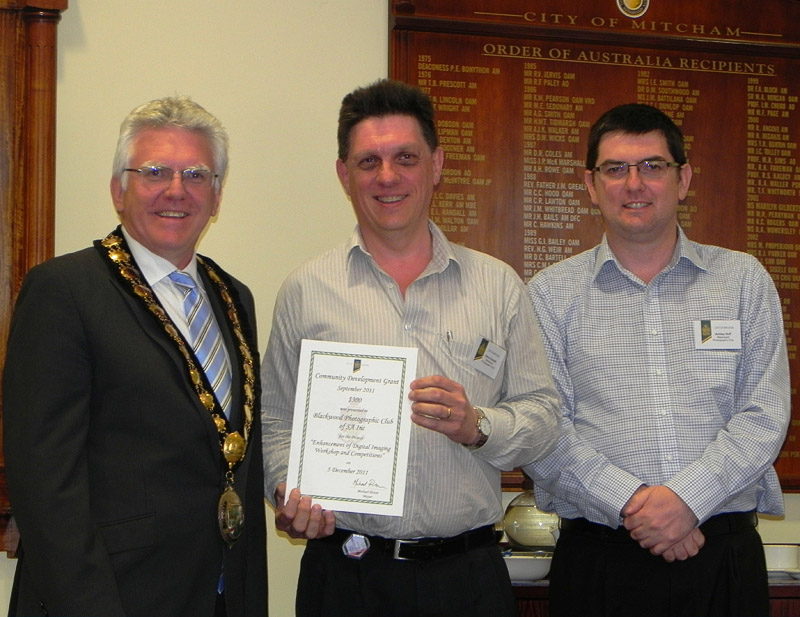
Chris Schultz and Ashley Hoff At the Mitcham Council Grants Reception
As the members of The Blackwood Photographic Club would know, in 2011, we received another grant from the Mitcham Council. This grant was used to purchase a Spyder Pro Monitor and Projector calibration device.
In Mid December, Chris and myself were invited to attend the official Community Development Grants Reception, which was held at the council chambers.
Our thanks and gratitude goes to the Council and the Grant Committee for accepting and approving our grant. We truly appreciate their continued support.
 Another competition night. This time we had non-SAPF judge Lindsay Poland from City Cross Camera House judging the Detail competition. Lindsay surveyed our work, and although he’s often happy to share opinions (wander in to the shop and have a chat :lol:) he was a bit less fulsome in his comments on this evening.