We were fortunate to have multi-award winning photojournalist Barry O’Brien speak to us on 28-Mar-2013. Barry was unsure if he could see us – as he lives in Gawler, but despite the distance, he made the trip and we thoroughly enjoyed every minute.
Barry is the current Australian Society of Travel Writers Photographer of the Year. Since leaving The Advertiser after 46 years, he was asked to return and produce two books, Moments in Time and also Moments in Sport. He is now a freelance travel writer, having stories published around Australia in News Ltd Escape sections as well as a variety of magazines. But that only tells part of the story of this fascinating photographer.
Barry started in 1956 at age 15 when his mum showed him an ad for a job at the Advertiser. He applied and so started a remarkable career. His first camera was pulled (not actually – but the same model) from a well worn aluminium case – a wonderful
Speed Graphic. With this camera, Barry had 6 plates of 4×5″ film he could use – 5 that were used on the assignment, and a spare for that shot that popped up when you least expected it. The Speed Graphic had a focal plane shutter, shutter speeds up to 1/1000s and 3 viewfinders. It was the work horse of press photography – but not built for speed.
Barry’s first front page photograph was George the orangutan at Adelaide Zoo. George was a much loved character at Adelaide Zoo and Barry wanted a special shot of George, and went to down Rundle Street and borrowed a football from the sport store of Hambly & Clarke promising to return it when done. Barry went to the zoo with the football – which George played with for a few minutes before proceeding to pull it apart. From that event a classic front page was born – and the sports store was not happy – they did get their football back. His association with animal didn’t stop there, with images of circus elephants escaping in the Adelaide hills (moral of story – have camera, will capture image!) which couldn’t be caught. He also developed a love for rodeos and even tried it – although the image of him falling from a horse after a few seconds was a touch embarrassing.
Apart from this animal work, Barry also did a lot of serious photojournalism, capturing images of significant events such as a major bus crash at Wasleys in the late 1960s. On this occasion, his camera failed him – it was night, his flash wouldn’t work (they were very finicky devices at the time) and he rushed to Gawler where he bought some Kodak Instamatic cameras from the chemist with flash cubes and proceeded to capture this horrific event. He covered other events such as the Bordertown bushfires and a lot of political events.
At the moratorium marches of 1969 Barry was looking for a unique image – so he stood behind the police motorcyle cordon, climbed on his trusty aluminium case and with a 20mm lens captured an image with the police in the foreground and the marchers approaching. This followed his mantra of shooting where someone else wasn’t. During that time in Adelaide, Barry was walking along the River Torrens one morning and came across a group of university students on the river bank being spoken to by one serious gentlemen. Barry was in the habit of wearing a suit at all times whilst working, and the speaker saw the camera and the suit and accused Barry of being an ASIO agent. Things got a little heated as the man ran for Barry & his camera whilst Barry snapped off a number of images – one of the man running making the front page. But politicians (& politics) were also shown as human – with images of them like Don Dunstan in the Le Cornus children’s ball pit, or Des Corcoran resigning due to illness. He also enjoyed capturing faces – such as a brilliant image of Chad Morgan.
His other passion – as hinted by the rodeo work – is sports photography like cricket & football. Once again, the camera case came into its own to help get above the action. However, as he pointed out the art is to catch the exact moment – so you need to know what is happening and anticipate it. Of course, not all images were spontaneous – many were staged. Some of you may remember John Platten at a very muddy MCG in gum boots, or South Australian Football coach Neil Curly wearing a Victorian footy scarf, or the image from the top of a light towers at Football Park (although Barry is afraid of heights). His fear of heights was tested even more when he crossed by rope between the HMAS Adelaide (on her maiden voyage) and another ship in mountainous seas.
A problem with being a sports photographer is that you get given other tasks, or where your equipment is not perfect for the job, and your subject is not in your own comfort zone. One such incident was the visit by Rudolf Nureyev & Sir Robert Helpmann. The image that he captured of Nureyev was frowned upon by the great dancer (and bears a cross from Nureyev across it as proof) – as his toes were not perfectly pointed down – and Barry managed to trip up Sir Robert in an area he was told would cause no problems. So much for the the arts adventure.
However, sport shots can also be very rewarding, such as aerial shots of events, and important images including those of Sir Jack Brabham & Stirling Moss at the first Australian Grand Prix in Melbourne (in the late 1950s) & then Adelaide subsequently. Barry also managed to capture other interesting images like the washed out 1989 Adelaide Grand Prix when the drivers went on strike. Barry however got a different shot – of Ayrton Senna in his car praying. That image went around the world as one of the great images of Senna. Motor sport can provide opportunities for unique images – just don’t be where the other photographers are working. Go down to the pits, take an image of a driver walking back to the pits all alone, show the pit crew celebrating. All unique, and all out of the main stream.
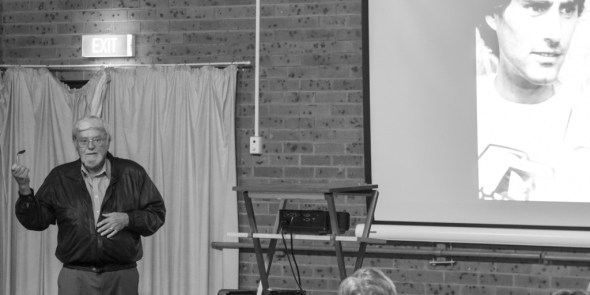
In addition to ballet stars, sport stars & politicians, Barry had the opportunity to photograph celebrities like Uri Geller – and showed us the bent spoon he still has from that photo shoot.
Barry told us the story of drug smuggler (and former athlete) Reg Spears pretending to be someone else, who was caught in Colombo. Barry had to fly to Colombo, via India at short notice to check if this really was Spears, and if so capture a photo and transmit it back to Australia for the next days headlines. The tale of travel, customs officials, bribery and equipment mismatches. The man was in fact Reg Spears, and when he met Barry confessed that the game was up! But that wasn’t the end of the story. Barry had to send the images back to Australia, but his power adapter was wrong for Colombo (despite being told it would be ok). Fortunately a lamp cord was pressed into service to help send the images and we saw the images the next day.
Barry also covered the Azaria Chamberlain inquest. In the process he got to know the Chamberlains, and understand what they had been through. He sometimes caught Lindy Chamberlain’s emotions, but these images were never used. Barry also obtained images without permission from the authorities as the Chamberlains were moved out of prisons in the Northern Territory – but only passed them to his editors despite offers of cash & rewards by other publishing groups. A result of his integrity and honesty was that when Lindy Chamberlain published her story, she asked for Barry to be the photojournalist who took the images exclusively. That is another interesting story involving messed up visas and cross border events.
So after a fascinating 90 minutes of hearing and seeing what Barry had done, we were given a few take home messages. Rather than paraphrase Barry, I’ll quote from his last email to me:
“What I wanted to get across was to think outside the square. Don’t just take the obvious. Think ahead. When I covered an event, (of any description) I would take the obvious so that at least I had a standard picture if all else failed. But then I’d look around for a different angle. I was probably considered anti-social by other photographers and cameramen because I rarely participated in the banter. While the others were telling jokes and discussing other things (which I’ll leave to your imagination) I was usually off to one side thinking about what I could do to be different. I hated bringing back the same images that were seen all over TV.“
Thanks Barry – we had a wonderful time and hope you can come back and share some more of your experiences.
Chris 😉