
Once more into battle we went – the BPC/EPC interclub – 4-Jul-2013
Yes – its that time of year again. The annual duel between Blackwood Photographic Club/Edwardstown Photographic Club. On this occasion we held it at our club on a night when the heavens opened. I can attest to that – I kept stepping in a puddle as I moved the selected prints, projection hardware and El Presidente paraphernalia between my car and the club rooms.
Despite the weather we had a good turnout, with 15 EPC members in attendance and about 30 from our club. For a change this year we did the scoring on 2 computers (ours and theirs). Judge Derek Mikolaj & I had joked earlier in the week about scoring with fractions. Oops – that got Derek going and he used just that system – Nine and a half, Six and three sixteenths, 8.95 – you get the idea! The scorers had a chore keeping up, but computers and spreadsheets can cope with these things – as long as you can convert a fraction to decimal (actually, you can do the calculation too – 7 and 3/8 is just that 7 plus 3 divided by 8). Anyway, we had a very good selection of prints (mono & colour), and 50 digital images to see. Derek worked efficiently through the images, giving constructive criticism along the way. These were the best images from both clubs – so marks were generally very high with eleven full 10s (not fractions). The competition proceeded with some wows, some not so wows and some witty remarks from both the judge and the audience. Who said we can’t have fun with the judge?
In the end, despite our best efforts (with images from 25 BPC members – every one gets an image in if they submit), Edwardstown won on the night. The scores? Well here is a little table:
| BPC | EPC | |
| Digital images | 220.1 | 226.9 |
| Monochrome images | 127.25 | 130.8 |
| Colour prints | 120.275 | 124.275 |
Total |
467.625 |
481.975 |
Once again, not a lot in it, but EPC took out every category, even though we had more full 10s on the night (7 vs 4) – but who’s counting? EPC have kindly allowed us to show all of their digital images on this page as well as ours, so rather than carry on any more about competitions, just look at the images and see which ones you liked the best. We’ve put the top scorers from our club in the Top Digitals page, and the slide show here of all the digital images.
To finish the night, BPC members laid on a great spread of supper (which seemed to go down well) whilst everyone checked out the prints still around and had lots of chats about the images. It was great to see the best from both clubs. Bring on next year – where we are going to propose some changes to open up the competition and level the playing field some more 😆 Chris 😉
Watch out! It’s the Paparazzi! – June 20th Competition
Watch out! It’s the Paparazzi! – June 20th Competition

Actually as Photojournalists I think we failed to net any celebrities but did manage to capture some interesting characters! Our Photojournalism Set Subject didn’t attract as many entries as Red the previous month but it was evident that many enjoyed the challenge of finding a story to tell. Judge Susi Lippert provided constructive comments on the whole and seemed to enjoy our selection of images. Keep getting out there and enjoying your photography folks! It’s great to see entries from so many different people!
To see the Top Scoring Images visit our Top Scoring Prints and Top Scoring Digital Images pages.
Helen : )
We Saw Red! – 9-May-2013

Whilst it was intended that we see a lot of Red on May 9th it could be said that there was more of this than expected. Judge Anne Emmett’s comments led to much animated discussion after the night where 115 prints and projected images, many in the Set Subject of “Red”, were scrutinised and criticised. Anne focused on the technical, pointing out how flat lighting, distracting elements and borders, images cut in half and lack of saturation could all spoil a photograph. Regarding saturation, she acknowledged that projected images could look very different on the screen to how they appear on our computer at home – a factor that a few of us have wrestled with over the years. (Hint: increase saturation and decrease brightness a little for Projected Images!) She also urged us to make sure we look for a different angle, to avoid taking the ‘standard’ shot and raised the question of whether a photograph has greater value if it was difficult to take. It was again great to see new members braving the competition with some appearing among the top scoring images. It was also good to see some very creative work with a number of people “thinking outside the box.’’ Hopefully we’ll continue to see a range of photographic styles, people being willing to experiment and try new genres and remember that we’re here to enjoy our photography and learn from one another.
To see the Top Scoring Images visit our Top Scoring Prints and Top Scoring Digital Images pages.
Helen : )
28-Mar-2013 – BPC Presents photojournalist Barry O’Brien sharing his experience

21-Apr-2013: Gorge Wildlife Park – Photographing Wet Animals
I had received a lot of in coming mail from people excited to be going on the club excursion to the Gorge Wildlife Park. It looked to be a big event – perhaps bigger than the outing to old Port Willunga. Saturday was quite sunny and a delightful day. On the Sunday morning however I awoke to torrential rain. It had set in a big way and was not letting up. The weather radar showed wave after wave of rain as a depression had settled in over the Adelaide region. Reluctantly I conceded that it was all over. I sent out an e-mail advising all to give the excursion a miss.
Later that afternoon I drove over to the gorge in case any had missed the e-mail and foolishly set off. To my amazement there was a contingent of 4 or 5 eagerly paying their entrance fee, cameras at the ready. “Hadn’t you got my e-mail?” “Oh yes, we got the e-mail, but we thought it might blow over and so we turned up anyway”. This was going to be a weird kind of day. I went in with Ron and Howard, meeting Kim and Ken and his contingent inside.
How do you photograph animals in the rain?
I suggested we retire to the shelter of the covered aviary, a large tin shed where we sheltered from the worst of the rain for over an hour or more. It was hard taking shots in the gloom. The birds however were interesting. Eventually it cleared a little and we were able to venture out and get a few photos. Despite the difficulty everyone seemed to enjoy the challenge of the difficult conditions.
One of the skills was in making the bars of the cage disappear. This is not too hard with a telephoto lens when you stand close to the cage and the animal is in the centre of the enclosure. However if the animal is large, standing close to the wire and the wire is lit up by sunlight, you might as well forget it. Sometimes it can make you swear. It seemed that a lot of learning was taking place as we mimicked each others style and tried different shots.
Eventually the rain let up, just as it was time to head home. It was hard to believe that they were telling me what a successful outing it had been. Needless to say I did enjoy interacting with the animals.
James Allan
Crossing Of Paths – A Meetup with Tea Tree Gully Camera Club – April 7th 2013
Part of the fun of being involved with a Photography or Camera club is the enjoyment you get sharing your passion with others who feel the same. Can you imagine how much more fun it is when 2 clubs get together?
On Sunday the 7th of April, BPC were invited to enjoy an afternoon of photography at Port Adelaide with the like minded people of the Tea Tree Gully Camera Club. Approximately 6 BPC members were in attendance and approximately 10 from Tea Tree Gully.
It was a very pleasant afternoon, exploring the treasures around the Port, Capped off with an interesting sunset (dare I say, enhanced with a massive Jet contra trail, which I failed to capture!).
Tea Tree Gully seem to be our cross town kindred souls, who seem to share similar values when it comes to photography and photography/camera clubs. If you would like to find out more about there club, you can view their website @ http://ttgcamera.blogspot.com.au/
Needless to say, I think a return invite will be very much in order for the spring!
Ashley
Science and Technology – 11th April 2013
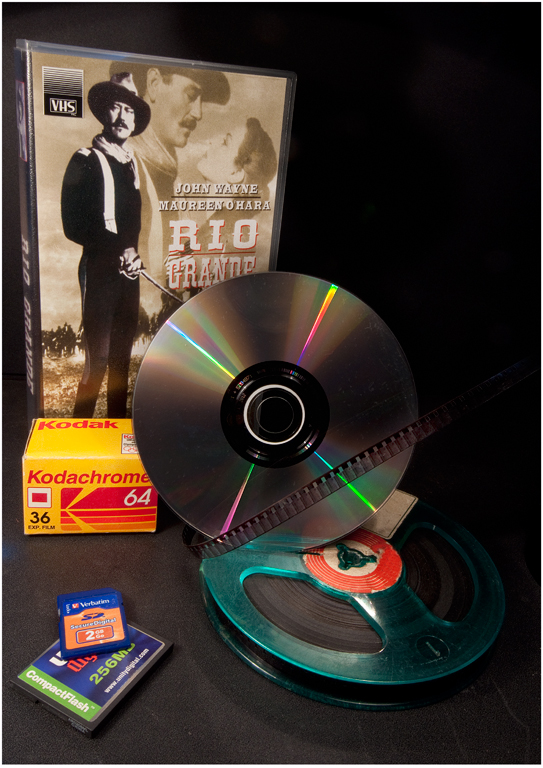
Eric Budworth_Different Recording
The competition subject was Science and Technology and, while some such as Eric embraced it, specifically setting up still life shots to illustrate the theme, many retreated to the ”safety” of Open competition, with the largest number of Open Colour Print entries in four years! There were a number of Nature Science photographs and quite a few focusing on structural/mechanical/engineering technology. The judge, Peter Phillips, drew our attention to the subjective nature of judging photography by simply taking votes on our favourite colour and pointing out that we all see things differently. He gave constructive comments and overall created a positive atmosphere. He seemed particularly impressed with the Colour Prints, showing appreciation for the diversity of subjects and attention to detail, and giving many 9’s and a few 10’s. Again it was great to see a number of people in the top scores, including some new members!
Click on the links to check out the Top Scoring Prints and Top Scoring Digital Images pages.
Helen Whitford
It Must Be a Sign! – 14-Feb-2013
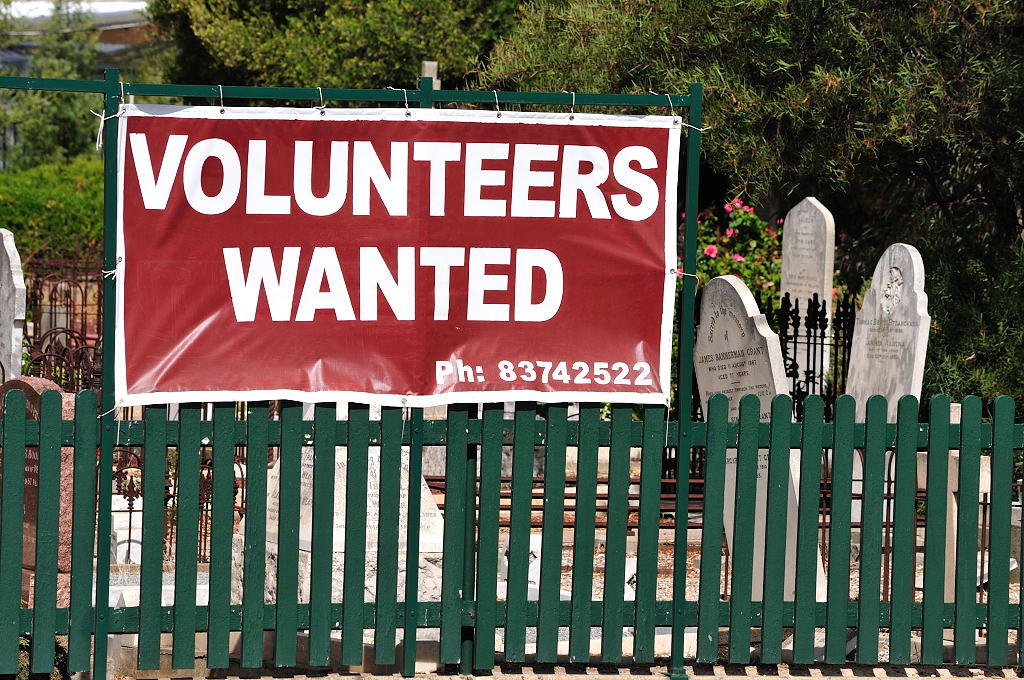
Volunteers Wanted – Ron Hassan – Set
Quietly ignoring the fact that it was Valentine’s Day a large number of members and visitors showed up to inform, point us in the right direction, mislead and confuse us with our Signs competition. Judge David Smith gave us helpful hints, tips and scores as he judged the 90 images, emphasizing the fact that he was presenting a personal opinion and that photography appreciation is very subjective.
There was an interesting range of ‘takes’ on the Signs theme though David noted that there was only one image that was angling for a laugh where Volunteers were wanted at a cemetery (thanks Ron!).
Eric’s Napoleon, Ursula’s Alpha Jet 01 and Chris S’s Rest in Peace impressed him the most. A large number of Open section images in a range of genres created discussion and inspiration. It was also great to see entries from a few of our newer members – they’re certainly throwing out a challenge to the rest of us!
To see the Top Scoring Images visit our Top Scoring Prints and Top Scoring Digital Images pages.
Helen Whitford 😉
Who wants to be a critic?
Record the date 31-Jan-2013 as an important date in your records.
On that day Blackwood Photographic Club embarked on a new direction that encourages more participation and sharing of photographic ideas. We moved from the mainstream camera club ethos of competition and into (what for us in 2013 is a new idea) actively sharing, encouraging and improving our photographic art as a group, as well as learning from each other and not just receiving a judges opinion.
Interestingly, the peer review/critique session is not a new phenomenon. Many educational institutions have done the same thing for decades (if not centuries) – the arts & literature need feedback to develop. The early days of our club embraced this method of learning, but it got lost along the way. Well, I think we’ve found it!
The night began with another significant event – the raising of the new projector screen!
Matt, Ashley & I spent a bit of time planning how best to mount the new screen – and after a bit of brainstorming, came up with the solution of clamping the screen to the ballet rail and raising the screen up. We did a test run on the Australia Day long weekend, and with a little paint, some more brainstorming, a ladder, some hand tools and a drill the new screen was ready. This method overcomes the problem of the mass of the screen, and therefore reduces the risk to the people raising it as well. We’ve employed the old widowmaker rods for raising it, but they’ll soon be replaced with something even better.
The big advantage of this screen is that we can now project our images at full 4:3 (just like your camera) on a larger, brighter screen. We must acknowledge the support of the SAPF in partially funding the new screen – which replaces our 30 year old screen.
The night was also significant for the debut of the new print stand. Eric built a new one just before the end of last year which is more robust, and allows prints to stand in a rail rather than be clipped into place. Even panoramas will now fit. Our sincere thanks to Eric for his efforts.
So on this already auspicious evening, we began our critique session. It was a pretty full house with many club members present & displaying their images, as well as 5 new members (welcome to Lesley, Ren, Grant, Gerry and Ron). We also had a few visitors – Peter & Richard from Edwardstown PC, Rosemary & Roger (2nd time – I remember 😉 ). Richard & I have corresponded about this new direction a few times as well – illustrating that our ideas find a resonance outside the club. We were also pleased to see life member Ruth Palmer attend and lend her support.
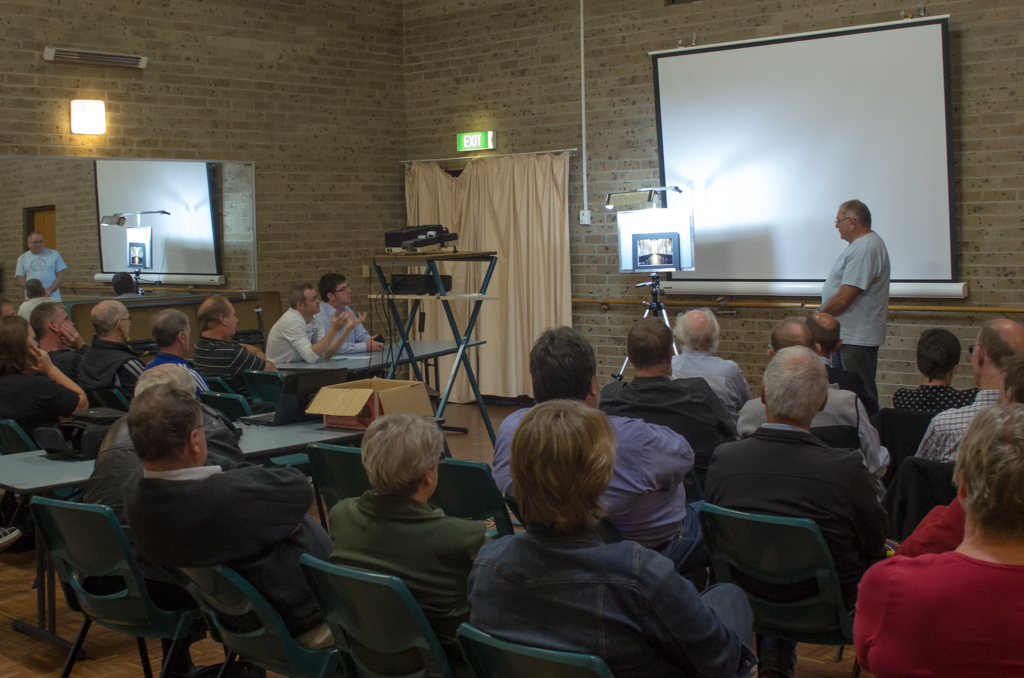 Critique using the new print stand too |
Our inaugural critique night (the modern edition) comprised Matt & Ashley as the review panel, with myself as chairperson, and images (print, slide & digital) from 18 club members. Not bad for a first draft. The initial concept was to have the images displayed in rounds of 1 image (or set) at a time. We thought that up to 3 rounds could be had in the normal meeting time. Each member was allowed up to 1 minute to describe their image, then the panel discussed the image, followed by comments from those present for a total of about 5 minutes. This worked reasonably well, except that the panel and audience ran overtime – repeatedly! That will have to be tightened up! |
A few observations about the process I mulled over afterwards:
- Some members put up images and basically said “What to do you think?”. In retrospect it should be “I was trying to achieve …… by doing …… – have I achieve it or how can I get there?”.
The critique this type of opening remark received was at times a little soft, but then the introduction by the photographer led to that. So next time you come along please tell us what your trying to do - Matt & Ashley tried to be constructive and make helpful observations. They prefaced some remarks with “a judge might say…..”.
Although this is valuable, particularly for competition, its not the only way to provide feedback, and they tried to avoid the cliches. Well done guys. - They also worked hard to give feedback on composition and technique – along with members of the audience such as Arthur (who I think commented on every image), Eric, Helen, Ray, James & Peter (apologies to those I missed).
Many other members chipped in too – and this is the important part of the night – we all took part.
I felt all those present were looking and trying to help the photographer improve the image – and not just superficially. This is something we miss after a competition night as the images get whipped down and stored. - Everyone stayed polite and constructive – brilliant!
- Members such as Helen, Heather, Theo & Eric displayed images to help them refine their display and technique. Helen addressed her ongoing screen calibration issue, Heather looked at image resolution, Eric showed us how to photograph drops of water & Theo addressed the issue of what is the best perspective – in close or out wide? All of this generated some excellent discussion in the process – and many of us – not just the authors – left with new insights.
- There was a good selection of prints on the night as well – with some valuable discussion on breaking the standard judging rules – the rule of thirds needs to be taken out and buried and sharpness need not dominate our lives!
- We ran out of time after the first round – hmmmm. Fortunately, we managed to have a 15 minute free for all with the remaining digital images.
Next time we will have to be a lot stricter on time limits - We were all enjoying it so much I didn’t see anyone doze off. Amazing! Some competition nights you can almost here the snoring – none evident on this occasion! 😀
Next time we’ll have another pair of panelists – everyone will get a turn (don’t be shy!). In fact thats another way of improving your art – by being made to give feedback to someone else.
So there you have it – the first installment of BPC Peer review. We’ll refine things as we go along. If you’ve got any ideas or observations I haven’t addressed email me or leave a comment on this page. I promise our critique nights will only get better!
Chris 😉
2012-2013 Stirling Library Exhibition – come and see!
After the success of last years exhibition, and with the support of Kelly Morris (Community Programmes officer at the library) we are back at the Stirling Library with another fine selection of images from BPC members. This time around the exhibition runs from 15-Dec-2012 to 14-Jan-2013.
So, after my appeal for images and also at the Annual Picnic, we now have 28 images on display for all to see – along with the usual catalogue and the El Presidente promotional blurb. There are of course the expected exhibitors but I’m pleased to say that we have a couple of new exhibitors including Henk & Yvonne. Thanks to everyone for pitching in – I was starting to panic as the deadline approached!
The images titles and authors are:
Photographer |
Title |
| Eric Budworth | Contemplation |
| Eric Budworth | Bearded Iris |
| Eric Budworth | Onkaparinga estuary |
| Eric Budworth | Melting watch |
| Chris Schultz | Guitar Man |
| Chris Schultz | Eye for detail |
| Chris Schultz | Little Dip sunset |
| Chris Schultz | Sunflower echo |
| Carolyn Beckett | Blue Hue |
| Carolyn Beckett | Just out of town |
| Henk Smelter | Nikki |
| Henk Smelter | Yarra by night |
| Henk Smelter | I’ll think about it |
| Mark Pedlar | Flared for landing |
| Jenny Pedlar | Gathering storm |
| Yvonne Sears | Reticent child |
| Melinda Hine | Glenelg Jetty |
| Yvonne Sears | The Obelisk |
| Helen Whitford | Mother and Child |
| Helen Whitford | Big Eyes Bakari |
| Jo Tabe | Wanna |
| Jo Tabe | Beachport Jetty |
| Jo Tabe | Marino rocks |
| Jo Tabe | Brighton Beach |
| Jo Tabe | Something in the air |
| Jo Tabe | Menindie Lakes |
| Hilary Thompson | Aboard the Falie (1) |
| Hilary Thompson | Aboard the Falie (2) |
If you have time, pop around and have a look at whats on show – and don’t forget to tell your friends who wonder what you do every second Thursday night! I’ve put the library hours at the end of the post.
Oh – and the images in the gallery below are from my phone – not bad considering. Click on any image to start the slide show.


Finally, on behalf of the Committee we wish you all a Merry Christmas and a Happy New Year! I personally look forward to catching up with all of you in the New Year and sharing in your photographic adventures!
Cheers
Chris 😉
The Stirling library opening hours over the Holiday period are:
| OPEN | CLOSED |
| Thursday 27 December: 10am – 5pm | Monday 31 Dec & New Years Day |
| Friday 28 December: 10am – 5pm | |
| Saturday 29 December: 10am – 5pm | |
| Sunday 30 December: 1pm – 5pm |
Normal hours are:
| Monday Tuesday Wednesday Thursday Friday Saturday Sunday |
CLOSED 10:00am – 6:00pm 10:00am – 6:00pm 10:00am – 8:00pm 10:00am – 6:00pm 10:00am – 5:00pm 1:00pm – 5:00pm |
29th Annual Exhibition wrap up – 2012
The BPC Annual Exhibition has been run, judged, awarded and examined!
Yep – all over. Thanks to everyone for their entries and efforts.
Judging night saw the well oiled BPC machine (with some minor hiccups) displaying a great range of images – album, colour & mono prints, along with the projected images, which this year did not include any slides. Thanks must go to Mark Pedlar for collating the prints in order ready for display, and Ray & Julie Goulter for their picture hanging skills 😆
Our judges, Lydia Strutton (Port Adelaide Camera Club and SAPF Secretary), Suzanne Opitz (Adelaide Camera Club) & Lindsay Poland (Photographic Wholesalers) worked their way through:
- 18 Album prints
- 39 Colour prints
- 19 Monochrome prints
- 35 Projected images
Of course being a panel judging, there was no feedback, and the scorers (Ashley & myself) diligently recorded the numbers whilst the audience sat admiring the work of their fellow club members.
Next years Annual Exhibition judging will be not be a club meeting to help reduce the no-doze consumption 😆
Two weeks later, after a bit more work, we were ready for the exhibition. Awards were engraved, certificates and the Annual Exhibition booklet printed, copies of everyones scores prepared, and Ray’s camera was fired up ready for recording the great event.
Many club members toiled to put up the images – with labels, so we could see who did what and have a chat about how images were captured and admire the creativity of our fellow photographers. On top of that a range of food was laid out for all to share whilst we surveyed the images – courtesy of our members! As one member pointed out, it was good just to have a relaxed evening talking about the images with each other. We were also honoured to have Lydia return to view our awards night and share in the fun.
So on to the results!
The winners of the awards & certificates……
Album Prints
Annual Aggregate
- JV Spick award – Helen Whitford
- 2nd – James Allan
- 3rd – Heather Connoly
Annual Exhibition
- Edge Malpas award – Jo Tabe : Beachport Jetty
- 2nd – James Allan : Fern frond unfurls
- 3rd – Adrian Hill : Kanyaka Ruins
Colour Prints
Annual Aggregate
- Blackwood Photographic Club award – Helen Whitford
- 2nd – John Vidgeon
- 3rd – James Allan
Annual Exhibition
- Mal Klopp award – John Vidgeon : It wasn’t me
- 2nd – Joe Tabe : Days end
- 3rd – James Allan : Common Brown Butterfly
Monochrome Prints
Annual Aggregate
- Blackwood Times award – James Allan
- 2nd – Heather Connolly
- 3rd – Jo Tabe
Annual Exhibition
- I’ve Been Framed award – James Allan : Lone Surfer
- 2nd – Jo Tabe : Lenswood Ruin
- 3rd – Jo Tabe : Something in the air
- Merit – Helen Whitford : Two of a kind
Projected Images
Annual Aggregate
- Photographic Wholesalers award – John Vidgeon
- 2nd – James Allan
- 3rd – Helen Whitford
Annual Exhibition
- Hutt St Photos award – John Vidgeon : Cat and Mouse
- 2nd – John Vidgeon : Balloons in grain
- 3rd – Jo Tabe : Wanna
- WEA APC Landscape Trophy – Jo Tabe : Wanna
I can see a pattern here – certain names just keep appearing! But seriously, all of you exhibited some great images, and although there are official judged winners, its not about the competition but about sharing and having a bit of fun.
So there you go – another Annual Exhibition over, another year over. All of the images from the digital section are in the Top Digital Images page – pop over and have a look.
Sincere thanks must go to Mark Pedlar for collating and organising the Annual Exhibition material (including certificates, the book, the score sheet etc etc etc), Helen Whitford for collecting/collating all the scores over the year, Yvonne Sears for organising the trophy engraving, doing those club secretary things etc, Ashley Hoff for running around and chasing things up, the scorers, image hangers, chair stackers etc, and all of you for participating, sharing your images and making the club function. If I’ve left a name or two out its just the lateness of the hour and I apologise in advance (check the post time – its after 1am!)
Have a great holiday break, relax with family and friends, keep those shutters firing, collecting images and enjoying your art. And don’t forget that next year we’ll be having those critique sessions – so collect the images you want to talk about.
Cheers
Chris 😉
The 2013 BPC Calendar is available!
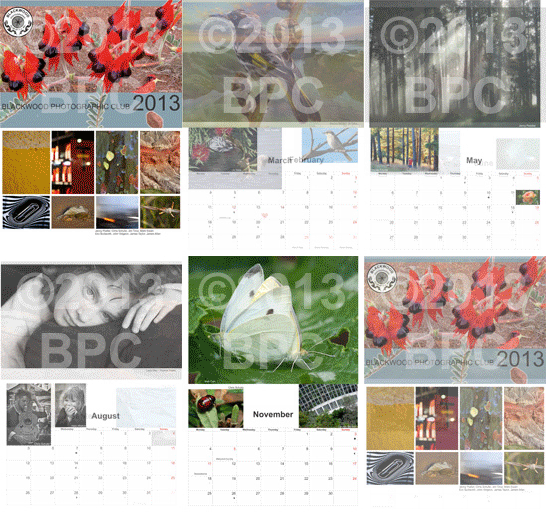 The low resolution sample above contains a watermark which will not appear on the calendar you purchase |
Its here! Our calendar Gurus – James Allen & Eric Budworth – have been beavering away at producing our ever popular Blackwood Photographic Club calendar. The 2013 calendar is again filled with mostly local, Australian, colourful, and stunning images from our talented members. The price remains the same – a snap at just $15. Give it pride of place on your wall, hang it in the office as a talking point with colleagues, give it as a memorable Christmas gift, let it travel to far flung climes overseas or interstate.Whatever you choose, its ready for you to obtain a copy from any club member, email us , or write to the club via snailmail (yes, we do have a postal address). We accept cash, cheques & money orders (payable to Blackwood Photographic Club of SA) and Electronic Funds Transfer (details available upon request) as payment for this great calendar. Please add $2.90 for tough bag postage/packaging mail delivery. Get your copy now and enjoy our vision of Australia |
Next year……interesting times ahead!
In case you’ve missed out on the news most of the 2012 committee is back! But with some new ideas!
Our sincere thanks to Jenny Pedlar for her work as Treasurer over the last few years – but as we knew, Jenny wanted to pass on that role, and so we welcome Carolyn Beckett as Treasurer. We also have Helen Whitford joining as a general committee member to boost our numbers and give a fresh perspective.
We also have a some new positions – an Outings Secretary which James Allan has consented to fill. James will endeavour to have an outing a month for club members to both provide a social focus and get more images in our catalogues. Mark Pedlar has agreed to co-ordinate the judges, and Julie Goulter is reprising her role as Social Secretary! In fact Julie has already earned our sincere thanks for organising the brilliant October Long Weekend outing at Robe. I’ve posted her report, but am still waiting on more images (although there are quite a few on Flickr)
On to the new exciting stuff.
At this years AGM, we had a discussion about the direction the club was heading in. I have had comments from members about judging, workshops and getting more out of the club. In my opinion we were in a rut, with the regular cycle of workshops/talks (which are generally very good – who can forget Stavros Pippos!) and competitions (which can range from good to downright awful depending on the judge and their comments). In fact, after one competition I had several members leave in total exasperation and frustration that they had learned nothing new and sat there listenning to one persons “egotistical rant”. That was followed up by several phone calls expressing their concerns.
We have all felt frustrated with judges in the past – including me. But it then begs the questions What is a photography club? Is it
- a social gathering of like minded people?
- a place to have some fun?
- there to help people improve their photographic skills?
- there to provide constructive critique of photographs?
- meant to be a discussion forum?
- there to help us push the boundaries of our photography?
- a place to learn about new directions in photography?
- there to provide a competition venue?
The answer is Yes to most of these questions, but one question should not dominate the others. Unfortunately, the last question – is it a competition venue? seems to have started to dominate our club. Thats not why I joined, and from what I’ve heard from many others its not the reason they joined either.
So how can we bring it back to the core values of enjoying and learning new photographic skills with a bunch of like minded people? To start with, how about having more outings and doing things together? Well, the Outings secretary and the Social secretary can address that. So theres a tick in that box.
What about learning new things? The workshops (both member and external visitor supported) address aspects that cover that. So another tick (although we need to know what you want too! Please tell us!).
Then the question of discussion and constructive critique arises. Now we have a problem. We can listen to judges comments at competition nights, but its not a discussion – its a lecture! Some are better at this and some are worse – more of the latter rather than the former in my experience. After a lot of thought and discussion with the committee, we thought it important that we give our members the opportunity to talk about their images and get constructive feedback. That gives us context. More importantly, it reintroduces dialogue – not just throw the image up, get it judged, put it away and say goodnight.
As a result, at the AGM, we put up a new proposal (I’ve put that in a PDF you can download and read) – to switch meetings to a rotation of 1. Workshop/Talk, 2. Competition and 3. Critique night. After some discussion, the proposal was passed almost unanimously! Now we have a chance to worry about competition less, and instead think about photography and push the boundaries of our skills. There will still be competitions (7 instead of 10), but there is now a real opportunity to have dialogue and share our thoughts. So now we have tick for that box as well.
So starting next year, there is a new programme (coming soon in the RSS feed) that encourages club members to share their images and talk about them. Don’t be shy – bring in your images, have a talk about it, listen to what others have to say about them.
This change will also introduce our new projector screen – which now has a 4:3 aspect ratio (ie bigger images) and is more reflective. We were fortunate to secure a partial grant from the SAPF (after some discussion) to help us replace our 30 year old projector screen. This week, Ashley & I collected the screen, and Matt & I spent Friday night planning how to mount it on the wall safely (the widow maker won’t do!) and store it. It will involve a bit of engineering, but we have a plan and should have it up for the start of next year! Thanks to the SAPF and the committee for helping to get this important piece of equipment replaced.
Speaking of the SAPF, I must mention the new direction they are taking thanks to SAPF President Alberto Guirelli and the new committee. Alberto spoke to us after John Hodgson’s AV presentation earlier this year. He came not only to speak, but to listen to what clubs want from SAPF. As he pointed out, SAPF is there to represent us and bring us together as a community. As you all know, Alberto is a fan of our little club and its attitude (a favourite of his is our little blog entry about judging for example). To bring about this change, he is actively seeking opinions from clubs, trying to get greater involvment from the clubs with the community, change the judging process (he has joined the pool of judges), and is trying to engender a change in attitude to bring modern ideas of photography into the process of judging and photography. That includes discussions with the AIPP about judging and a national standard, increasing the range of images we and the judges see and more focus on the art (and impact) rather than the technical aspects of photography. We can help by joining with SAPF in pushing the boundaries of judging, and criticising them if they don’t meet the standards we want – so we need to ensure we submit judges critiques to Keith Siedel and the SAPF judging team. Alberto reminded us of the mantra that many of you have heard from me – shoot for yourself! Please support Alberto and his cause – I feel that he is bringing back relevance to the SAPF and that has to be a good thing for all of us.
The final thing I’d like to mention is the new Australiana Landscape Trophy in the Annual Exhibition which is being sponsored by Ursula and Theo Prucha. Many thanks to the Prucha’s for sponsoring this award and giving us something new to try and achieve. I’ve put the description of the trophy and its rules into the Awards page and the Annual Exhibition entry form.
Another of the changes we have planned for the Annual Exhibition next year is that we are going back to tradition and not going to have you all sit through 2 hours of silence whilst the judges look at images! We’ll have the judging outside of club hours with just the committee and then have the Annual Exhibition with everyone seeing the images for the first time and awards handed out so we can have a decent discussion about the assembled images!
Enough of El Presidente’s thoughts – see you all soon at the Annual Exhibition judging (bring the NoDoze :D)
Chris 😉
October Long Weekend 2012 – Robe
ROBE SA – Friday 28 September to Monday 1 October 2012
Who attended:
- Julie Goulter (The Organiser)
- Ray Goulter
- Jenny Pedlar
- Mark Pedlar
- Helen Whitford
- Russell Whitford
- Eric Budworth (El Professore)
- Rhonda Budworth
- James Allan (Captain Click)
- Frances Allan (Madame LaFarge)
- Chris Schultz (El Presidente)
- Yvonne Sears (The Quiet Achiever)
- Jo Tabe (Bird Woman)
Where we stayed
A rental property in the heart of Robe. The house was very comfortable and provided all the amenities we required.
Where we went and what we saw
Saturday
Small groups headed in various directions on Saturday morning to see what was interesting around the town of Robe. Beacons Hill Lookout, the Boat Harbour and the Main Street to name a few spots. Along with photographs being taken a few tried out the local coffee shops. What a relaxing way to start the weekend.
Everyone returned to the house for a casual lunch – those who were hungry ate, those who weren’t watched.
In the afternoon many ventured to the Boat Harbour but it was quite windy so it was decided to move on to the Obelisk and surrounds. Although the wind was chilly it made for some wonderful photo opportunities of the coastline and the waves crashing on the rocks. Chris Schultz wandered off the track and headed to the cliff edge to see what other images he could come up with.
Ray and Julie took a few minutes to visit the Royal Circus and Customs House, now a small but very interesting Maritime Museum. The caretaker told us that the town fought to stop the historic old building being knocked down. Thank goodness another piece of our history was saved by local intervention.
On our way back to the house they also visited Mahalia Coffee where the master roaster of a vast range of coffee beans prepares and sells his beans and ground coffee. Coffee and other local produce was purchased.
Saturday night a selection of salads, both hot and cold, were provided by various members and the steaks, chops, sausages and chicken were grilled to perfection on the bbq. Dessert for those that felt inclined was blackberry self-saucing pudding and yoghurt (oops, forgot the ice-cream).
This was followed by an evening that was relaxing to the body but tested the brains of all the guests. A game of lateral thinking, quirky questions for you to ponder and mysteries to solve.
Sunday
Beachport today, about a thirty minute drive from Robe.
The first stop for some was the Woakwine Cutting, an area that was once just swamp and had been cleared and drained to create beautiful, lush grazing area for some of the best Hereford cattle in the district. A shower or two of rain fell but not enough to stop us looking around.
Upon arriving at Beachport we noticed a large group of people gathered adjacent to the jetty. This evoked much discussion about whether they were there to scatter someone’s ashes off the jetty. As we watched with interest from the Jetty Café across the street, we were told it was not a wake, but the Blessing of the Fleet to open the fishing season.
Following morning tea at the Jetty Café we again broke in to small groups and wandered around the wharf and township to see what caught our interest. We all met back at the bakery for lunch and a chance to compare stories of what we had seen and done.
Mid afternoon several of us headed out to do the Bowman Scenic Drive after a slight hiccup which took us out of town. Once on the right track we discovered more areas of rugged coastline and some interesting rock formations caused by tidal movements and erosion over many, many years.
Late afternoon on the way back to Robe a few detoured into Little Dip National Park, in particular to the Little Dip Surf Beach. Once again the rock formations and choppy seas provided some interesting subjects.
Another BBQ that night and a relaxing chat around the table. A few of the members decided to take advantage of the full moon and headed down to the harbour for some night photography.
Monday
Our last day saw us all up bright and early for breakfast and packing up. We were out of the house around nine so stopped off at a café in Robe for a cuppa and to decide our movements for the trip home.
Some wanted to see more of the national parks on their way to Kingston. For the rest of us the first stop was Wangolina Station Winery. It was a bit early for wine tasting but the owner was happy for us to wander around all the old sheds and outbuildings. Jenny spotted a huge flock of black cockatoos in the distance and a couple of kangaroos. We were then told that a short time before we arrived there had been about 60 kangaroos in the nearby paddocks.
From there we moved on to Cape Jaffa, where the lighthouse once stood. The first thing we noticed was the very strong smell of fish. Understandable when it is a popular fishing spot with the locals. A quaint old jetty and more of the rugged coastline provided some interesting photography subjects.
Our last port of call was Kingston where we visited the the Cape Jaffa Lighthouse in its new home opposite the foreshore. A quick drive across town brought us to the Big Lobster, a well-known tourist attraction. It was there that we met up with the other members and all sat down to lunch. Eric and Rhonda Budworth had already headed for home to beat any holiday weekend traffic into Adelaide but the rest of us congregated around the ‘Lobster’ for one last photograph before we all wended our way back along the Coorong and home.
The accommodation was good, apart from a few little issues and the weather was overcast but kind to us from a photography perspective. A sincere thank you to all who participated and for the spouses who also joined in the experience. Thanks also for the various contributions of food and drinks. We hope everyone had a great time and we look forward to our next trip, wherever that may be.
Two questions to ponder from the weekend away….
Does size matter?
Is height important?
To find out the answer to these and many other questions join us for our next exciting adventure!
Julie Goulter
BPC Social Secretary
Catching up on a few competitions……..
My apologies to those that have been hanging out for a few words about competitions over the last few months – we’ve been a tad busy with other things (another post will describe that)!
However, all is not lost – the images have been posted for your viewing pleasure.
I’ve been away for some of the competitions, so I won’t comment about those, but I will pass comment on the the most recent competition I managed to get to – Low Light photography. The night was judged by Keith Siedel (of Edwardstown club & now the SAPF judge co-ordinator). We had a broad range of images for the evening – some that were fairly routine, and some that pushed the boundaries of low light imaging – including one very clever slide by Arthur Farmer entitled 5 minutes at f8 – the title says it all!
Keith’s judging was very constructive – and despite the number of images each images pros and cons were given! Some of the points to come out of the judging were partly personal preference, but also some basics that always work:
- People add interest to an image – even in low light
- Silhouettes are always an option
- Tight cropping is not always the answer
- Monochrome with incandescent light is a good alternative to colour
- Red colours in a print always work
- Try to capture the shape and form of landscapes – not just the broad sweep
Afterwards we had a good discussion about some of the images – including correcting some of the judges mis-understandings (like the car airconditioning button being on during a cold night in one image).
I’ll leave Ashley or someone else to post comment about the other competitions.
Chris 😉
Noarlunga Expo 2012
On the Friday prior to the Noarlunga Photographic Expo. I spent most of the day try to assist the volunteers set the hall ready for the weekend’s function. My wife had been busy cooking up some treats for sale at the event for those attendees who wished to have a “Cuppa and Cake”. These cakes and cookies along with more treats which other club members had baked, were sold thus raising much needed funds for the club.
Saturday, the first day of the Expo, started quite well with a steady stream of visitors through the doors. The organising committee were expecting a possible lower attendance on Saturday due other functions being held for the Shimmer Festival and the Crows playing at Football Park. This expectation however proved to be a myth as the public kept entering at a steady rate right up until the closing time of 4 o’clock. Some members of the public were still trying to enter after the doors were closed.
Sunday was also a quite well attended day with lots of interest in the local clubs, all of the BPC programs that I placed on the display were taken and a few people took down notes of our address and meeting times. I dispensed information about our club as well as photographic advice to members of the public interested in the possibility of joining.
All of the clubs displays were very good with the Hallett Cove year 11 & 12 students being an excellent display.
I found it strange that the stand used by Photographic Wholesalers was not staffed by anyone! At one stage I was asked if I could help some young students who were enquiring about studio flash units and their usage, this was due to me standing adjacent to the PW display whilst talking to Tim Newbury. I tried to assist these young photography students as much as possible.
The Noarlunga CC had their calendars on sale for $10.00 each and I must say they did quite a good trade. A glass display cabinet with some old cameras and photos were on display of which yours truly supplied most of the equipment. There was one old photo of a couple of bicycles which were joined together so that they were ridden side by side with a young baby seated between the riders. The photo was taken about 1923 and later on Sunday afternoon the “baby” came to visit the Expo !! she is now in her mid nineties and quite well. It was a joy to meet her and have a chat.
A raffle was held and drawn at the close of the show on Sunday and the number of people through the doors over the weekend was in excess of 500 this was confirmed as the public were issued with a ticket on entry (although some may have sneaked in without accepting ticket) so as to be able to verify the attendance numbers.
All in all I felt it was a good show and thanks must go to the Noarlunga CC for the fine job they do each year in organising this event.
It was also pleasing to see some of Blackwood Photographic Club members putting in an appearance at the Expo.
Prints displayed at the Expo by BPC will be returned at the next meeting. Thanks to all who participated.
Eric Budworth
Water with movement – 16-Aug-2012
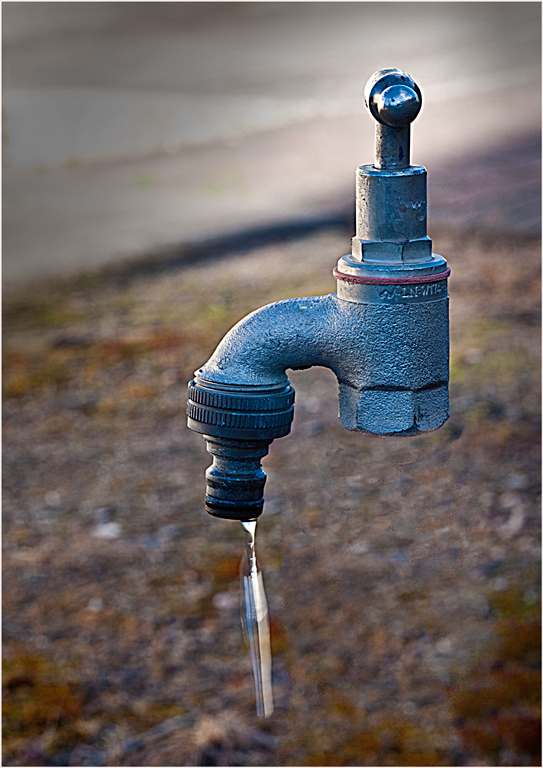 Despite the cold and rain Thursday August 19th saw a good turnout and a high number of entries in all sections of the competition, with the Set Subject of Water with Movement well represented. Thanks must go to Kym Farnik, an experienced photographer and judge who filled in at late notice and judged in a fairly consistent and positive manner whilst acknowledging that judging is always subjective and that people may not always agree with him. (And of course, we sometimes didn’t!)
Scores covered a wide range with Kym choosing a single top image in each section to receive a 10. He seemed particularly impressed by James Allan’s Spoonerism and Ursula Prucha’s Dolphin. He complimented the club on a high overall standard, while giving constructive criticism and suggestions for each image. Once again tighter cropping was a frequent suggestion!
It was good to see a number of entries from new members to the club!
Cheers
Helen
Edwardstown – Blackwood Interclub – 17-Jul-2012
The annual competition – this time at Edwardstown’s rooms at Glandore. We had a good turnout from BPC members (14 in all – plus a few apologies) which was very pleasing. The judge for the night was Des Berwick, from Adelaide Camera Club, who evaluated our images efficiently, with generally constructive comments to help the assembled photographers.
A total of 110 images were presented by both clubs – our digital selections are below:
The results
Blackwood |
Edwardstown |
|
| Colour prints | 117 | 116 |
| Monochrome prints | 101 | 114 |
| Digital images | 186 | 195 |
So we didn’t win, but we weren’t embarassed either. Congratulations to Edwardstown – but as we both said – its not about the competition but about having some fun.
For the benefit of BPC members, here’s a list of our top scorers in each category:
Digital |
Colour prints |
Monochrome prints |
| Port Augusta sunset – James Allan (9) |
Mother and child – Helen Whitford (9) (Also an SAPF award & Trophy winner) |
Floating Clipper – Eric Budworth (10) |
| Jaguar reflection – John Vidgeon (10) |
Gap in the fence – Hilary Thompson (10) |
|
| Cat and mouse – John Vidgeon (9) |
Giant Cuttlefish – James Allan (10) |
|
| Eye for detail – Chris Schultz (10) |
||
| Giggly squirt – Helen Whitford (9) (Also an SAPF Trophy winner) |
Edwardstown also put on a very pleasant supper – thanks for that! We had a look at the images, chatted to a few folks including the judge (no – James’ swimmer did not have a crooked horizon & my guitarist did have a fret board that was discontinuous :lol:), and had a good look at all the images. Regardless of the outcome, a pleasant evening was had by all, and we look forward to returning the favour next year at our place.
Before I sign off, I will register a small note of protest here – Des had judged at the SAPF Annual Exhibition and a number of the entries were exhibited at that event – so perhaps the judging was slightly compromised (in which direction I can’t say). Des himself admitted that it made his judging more difficult. Perhaps both clubs need to think about a change in scheduling or judge selection for the evening to help both the judge and the clubs.
Chris 😉
Print making – a couple of professionals share their knowledge – 5-Jul-2012
Some of you may recall the comments last year from guest judge Lindsay Poland on the quality of printing in one of our competitions – and it wasn’t all favourable. So to help us improve things, we invited Lindsay back to talk about making prints. Lindsay is also friends with Steve Huddy from Canon, and managed to get Steve to come along too and share his knowledge of inkjet printing.
To start proceedings, Steve told us little about himself and the history of inkjets. Steve was once a professional photographer who cruised on Fairstar liners – and he shot Nikon (not Canon) for a long time. In those days it was all film. When the first good quality, manageable digital cameras appeared, like the Nikon D1 (the same as Eric showed us a few weeks ago) it was a revelation. At some stage, Steve switched brands – but that’s another story.
Of course, once you have digital imaging, you need to print the images. You can of course use professional labs (like I do), but you can also print at home (like a lot of you do!). Enter the inkjet printer!
There is also a story that Steve told us about technician who accidentally put his fountain pen on a hot soldering iron. He didn’t realise his error, but a few minutes later ink squirted out of the pen, and the inkjet printer was born. In fact, story of the inkjets dates further back to around 1867 when Lord Kelvin patented a continuous (pumped) ink stream method directed by an electrostatic charge to mark products (didn’t know that did you?). But the first commercial version didn’t appear until 1951 and was mainly used in chart recorders. An IBM inspired idea was contracted out to InkTronic (according to one blog I read), which developed this further in the mid 1970s creating a matrix type printing system, but the quality of the printing wasn’t great. Other inkjet systems developed soon after using different methods – heating the ink through a matrix of small heated nozzles which bubble out the ink (think Canon, HP & Lexmark/IBM) and piezoelectric head which changes shape when a charge is applied and ejects ink. from (think Epson & Brother). Incidentally, there are also thermal wax “inks” that work a bit like a laser printer and don’t run when they get wet (mainly Fuji-Xerox) – but these aren’t aimed at the home printer. There’s a Wikipaedia article on inkjets if your interested in more detail – and a stack of other material you can find with an internet search.
The inks that are used vary as well – either pigment inks which are particles that sit on the surface of the paper or dye inks which soak into the paper. Pigment inks are ideal for B&W images. We worry about the longevity of the these inks compared to silver halides and manufacturers now quote a 300 year life span (under glass and on a wall) but only 100 years if exposed to air and light – a long way from the inkjets of old. This improvement in ink quality has led to many professional photographers now using inkjet printers for both proofing and display. For example, internationally famous wedding photographer Yervant (who recently gave some talks in Adelaide – and 5 BPC members attended) now uses inkjets. Part of the reason is that he perceived that 30% of the work is taking the photo, 20% is marketing, but 50% is the post production work which the photographer must do to realise their vision. Another example is Adelaide born photographer Robert McFarlane, who recently at recent retrospective display of his work at the (the Art Gallery of South Australia also have a permanent collection of his work as well) showed inkjet printed works – and is reported to have saved over $2500 compared to conventional prints.
To demonstrate the current generation of inkjets, Steve brought along a Canon Pixma Pro9500 Mk II printer – capable of printing on A3 using 10 colour ink cartridges using 6400 jets. This class of printer has a price tag to match though (over $800) plus inks (about $350 for a set of cartridges) – but has been superseded by a newer model that retails for about $1500. He also printed two A3 size images – one full colour and one in monochrome. If anyone is interested we have the images in our store cupboard (will they last 300 years in there? :lol:).
The important thing to note about using inkjet printers (and papers) is that they must be colour profiled along with the screen. Some large printing houses (such as Atkins) can provide the colour profile of their printing equipment to allow correct colour matching.
The question was asked of Steve – why are printer inks so expensive? The answer is that the printers are almost given away, and the cost recouped with the ink cartridge. The manufacturers of course don’t want you to use third-party inks, as they are not reverse engineered versions of the original inks, and are claimed to clog heads etc. I won’t get into that argument, but if your going to produce inkjet prints for competition or display use the best materials you can. Fortunately the ink wars don’t apply to printer paper, printer manufacturers now allow multiple papers profiles to be used from any manufacturer.
Lindsay then took up the conversation, talking about his own workflow. He has 22 years experience in the printing in the wetlab – and more recently the digital world. The difference as he points out is convenience vs control. Wetlab printing uses an sRGB colour space (see Jame’s Camera Clips for December 2010, February 2011 & September 2011 and for a discussion about this) with an array of 3 LEDs and any corrections are fairly basic – most must be done before the printing stage. Inkjet printers in contrast allow finer control – like a wetlab but still in an sRGB colour space (for reference, there is also Adobe RGB colour space – that’s used by offset printers that use CMYK). sRGB is adequate for most printing needs, and covers most colours we can perceive.
When we print in black and white, there may be a colour cast. This is a result of either the printer generating the black from mixing colours or a cast applied in post-processing. Better quality inkjet printers overcome some of this by having different shades of grey – not just black ink. The important part – again – is to profile the printer correctly and convert the image to grey scale.
The important part of that workflow is making sure his monitor and printer are calibrated correctly. For that he uses a spectrometer from ColorMunki from X-rite which allows him to calibrate the screen and importantly, the printer as well – a 30-45 minute process in total. Fortunately, the paper and printer only need calibration once, but the monitor is regularly checked (for those that aren’t aware, we have a Spyder 3 Pro spectrometer which allows us to calibrate screens only – club members may hire it for $10 + $10 bond).
Like the inkjet printers, papers also have calibration requirements. The International Colour Consortium (ICC) have a profile for each paper which may be downloaded from the manufacturer website. Lindsay uses Ilford Galerie papers – including a wonderful new 310gsm paper that’s like traditional baryta (barium sulphate) photographic paper that allows a high colour gamut – Galerie Prestige Gold fibre silk 310gsm
Once calibrated, the workflow can begin. Lindsay uses Adobe Lightroom where he will check & adjust exposure and sharpness. A useful tool available in Lightroom 4 is soft proofing. This allows you to check how the final image will look on paper before printing (and so save money) – but it only works if the screen is correctly calibrated.
When printing, a couple of tips from the professionals we gleaned:
- Don’t print at High Quality – it will just use more ink and you’ll get nothing extra. Just use standard or normal
- Allow the prints to dry to get full colour saturation – it can take a few minutes
- print at 360dpi – that’s more than adequate
- streaking on your prints is probably a result of dirty print heads – clean or replace them
So there you have it – words of wisdom about printing images to the highest quality. And I think the take home message is calibration!
Cheers
Chris 😉
Detail – 21-Jun-2012
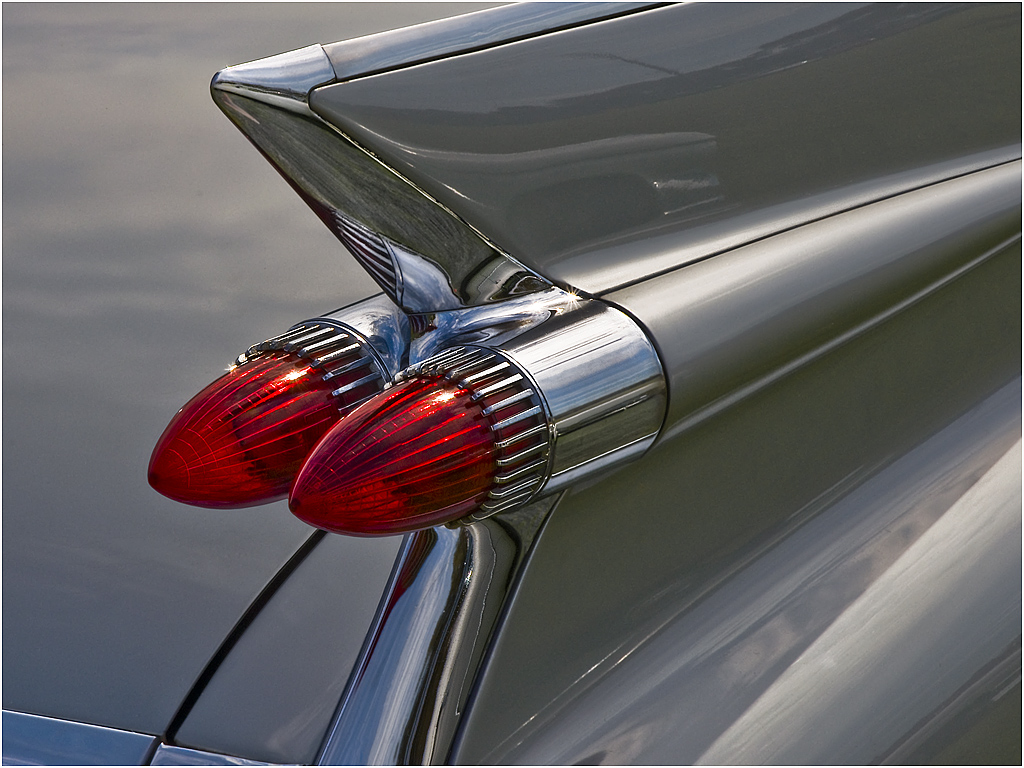 Another competition night. This time we had non-SAPF judge Lindsay Poland from City Cross Camera House judging the Detail competition. Lindsay surveyed our work, and although he’s often happy to share opinions (wander in to the shop and have a chat :lol:) he was a bit less fulsome in his comments on this evening.
That worked to our advantage as he quickly judged the images, with some minor critical comments, and as always reserved the highest marks for the absolute best images (no one got a 10!).
But what we did afterward I think added to the night significantly – I asked him why he awarded the images the marks he did – from the low to the high. For example, Jenny Pedlar’s blue door was a great image and he really liked it, but he down graded it a bit due to some distracting elements in one corner. There was a bird print from James that got a lowish mark – the reason was due to what appeared to Lindsay to be over sharpening. A high key image of my daughters eye was down graded as he felt it needed some more of her face (not just her eye) – to make it more of a story than a clinical image (fair comment). This sort of Q&A generated some interesting discussion from the floor which went on for another 20 minutes and I feel was more productive for many of us as it was a conversation between us and the judge rather than wisdom from upon high.
So if you are all willing, we might try this with some other judges as the year progresses and tease out far more than the thinking out loud we are used to hearing. In the meantime, check out the top digital images (sorry – haven’t had time to get the top prints from authors)
Chris 😉
Jeremy Watson – professional photographer – 7-Jun-2012
Workshops have been a touch tricky this year – our guest speakers or events haven’t always worked out or been available, and this evening looked like being the same! The night was supposed to be about Antarctica, but we had to find a guest speaker at very short notice.
Fortunately, Jeremy Watson (of that great natural light portrait evening) agreed to step in at the last minute. Jeremy told us a bit about himself:
- His work takes him away from home for 3-4 months – usually to the bush
- Jeremy runs education sessions for ArtsSA at Carclew, and for SA Health. The workshops are very much participatory events and often involve mental health, disadvantaged groups or juvenile detention kids – the main point being to engage people. This can be used to advantage in school setting too with team building exercises.
In all cases, strong outcomes are sought, bombarding the participant with creative, high energy material – homework is optional! - If you’ve been to the Royal Show you may have an Ikea catalogue – with your picture on the cover. That was Jeremy’s job (very hard work!!!), but he also runs a lot of pop up photo sessions for people like SANTOS or the Motor Accident Commission
- There isn’t a lot of marketing in his other work, which these days is mainly digital and straddles both commercial contracts and visual arts.
- He has some exhibitions too – cafes, pubs, restaurants if your interested.
So as you can see, he has a lot to occupy him and tries to have a range of jobs that keep him occupied for a good part of the year. Have a look at what Jeremy is working on at present and you get the idea:
- A youth workshop at Streaky Bay for 12-25 year olds with a fashion stylist
- a 20 year retrospective of his work
- Pop up photo booths for Schoolies
- a new portrait folio
- a book for a church
- feet for a beautician
- Red Cross Drug and Alcohol programme
- the migration team to help refugees
- a project with children in Sri Lanka
We got onto some general discussions like Why do we take photos? The answers that popped up from the audience ranged through capturing beauty, autobiographical, needing an audience (don’t we all?), sharing (yep!), getting new ideas and discussing photos. Now aren’t they the reasons that a lot of us are members of Blackwood Photographic Club?
Jeremy suggested if we want to extend ourselves try setting an assignment – find “faces”, shoot colour, take candid shots. We had a bit of general discussion about candid photos. Jeremy found that people in Australia aren’t as shy about having their photos taken as we think. He showed some images he’d taken in New York (he’s been there and used a point and shoot rather than dSLR to really get involved) and said Adelaide wasn’t really that much different.
If we are to take photos be aware of some of the rules. There is no actual right to privacy although we have a reasonable expectation of it. The important distinction is that if peoples images are used commercially (ie for profit/sale) that’s a possible risk of litigation if they have not consented. On the other hand, places like the beach are public places, as are city streets and there is no law restricting photography per se. Be overt about taking your photos, don’t be timid, and even share the photos with the subjects. However, there are restrictions regarding children, private property, Defense department land, Sydney Harbour Bridge foreshore and others. There is a discussion going on around the world about this, and situations where people try to forbid you to take pictures (eg security guards) may not be a problem after all – but check the situation. Have a look at the 4020 and Arts Law web sites for more information – there is quite a bit about it.
Jeremy then asked if we’d do a questionnaire to help him frame workshops for groups such as ours – and talked about getting the most out of your images as we answered his questions. Things like:
- understanding your camera
- photograph what you love
- change your white balance
- use different view of your subject (low/high/left/right/above/below etc)
- shoot to a brief to test yourself
- Shoot wide angle
- use Photoshop to try tilt & shift for correcting architecture
The discussion moved on to some images that Jeremy brought in of his work – ranging from product shots, to portraits, multiple prints on one sheet (that reduces cost), adding grain to images (gives it that film feel) and some tasteful human form studies in various environments. He noted that digital photography has affected professional business (as everyone’s a photographer now!) and this is now reduced, and so value has dropped. Interestingly, darkroom prints have become more valuable.
So after a wide ranging discussion, Jeremy went away with his questionnaire, and we went away with some ideas about what professional do and how they survive in a cut throat world.
Oh – and before I forget, welcome to new member Peter (who’s also in Edwardstown – but we won’t hold that against him :lol:)
For those that missed it, Jeremy has organised a portrait workshop (at a cost of course) – which filled quickly – and 8 of us will be taking part. Others will occur if there is sufficient demand.
Cheers
Chris 😉
Seen Better Days – 24-May-2012
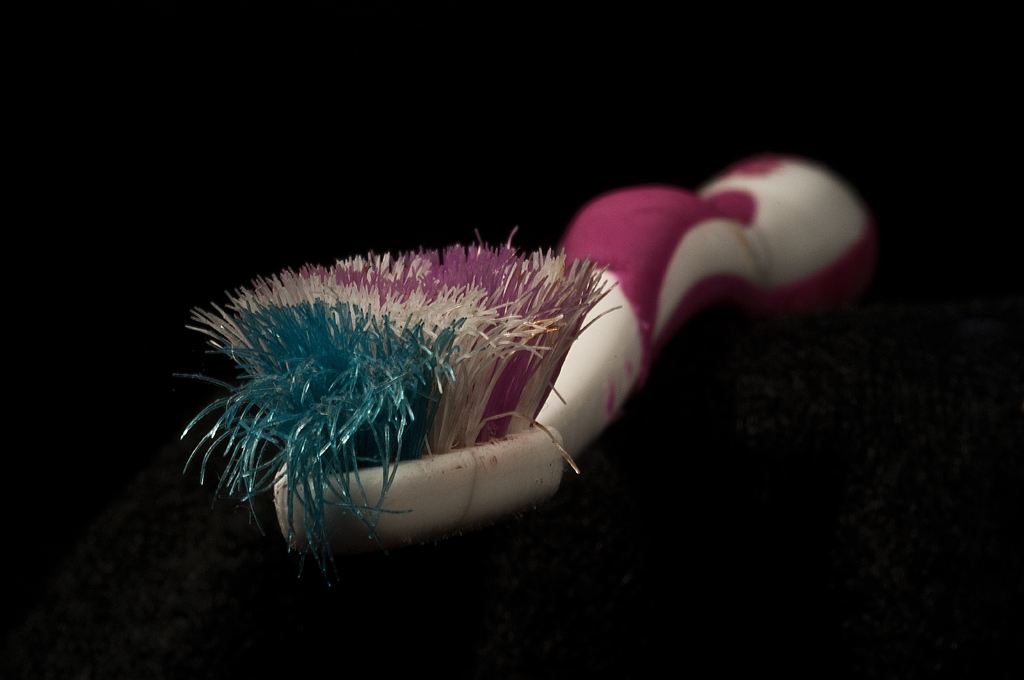 Another competition to try out our skills and test the judge! A cold, wet night had a good gathering present to compete and enjoy some fine images. We also had two visitors – Antoinette & Howard and two former visitors decided they liked what they saw – welcome to Chris and Peter. Hope you get involved in the workshops and competitions soon!
On the subject of judging, when you get a chance have a read of James Allan’s piece on St Peter in the latest Camera Clips – it will make you think about what the judge has to do.
Before I get into the evenings competition, a few house keeping items:
- 7-Jun-2012: Will now be Jeremy Watson (of the Natural light portraits evening!) talking about his work and what people would like at workshops
- 17-Jul-2012: Edwardstown interclub – get your images organised soon. We will want final image names at least 1 week before the event
- 2-Aug-2012: Now the AV night with John Hodgson
- 30-Aug-2012: Now the Antarctica talk (and possible Astrophotography too!)
Outings
- We are working on a Queen’s Birthday outing – I’ll send out an email with the plan, but if your free on the Monday we should have something for you. If not, James Allan will be in Whyalla swimming with the Giant Cuttlefish and your invited to join him.
- We are also finalising the October Long Weekend outing – more soon.
Exhibitions
- The SAPF Annual Exhibition
Venue: United Eastern Association Masonic Complex
1 Fisher Street , Tusmore, SA, 5065
Exhibition Dates:
Saturday 14th July 2012, 12.00 noon through to the Official Opening at 7.30pm
Sunday 15th July, 11.00 am – 5.00 pmWe have now sent off the images to the SAPF exhibition. The club aims to exhibit an images from each member who submits an image (we are limited to 2 by the rules), but we are only allowed to exhibit 10 images in total. We were actually oversubscribed on this occasion, with more exhibitors (and images) than we were allowed, so we had to choose the best of each potential exhibitor, and then reduce that to 10 out of that group. Selection was based on a vote by the 9 committee members present.
Our apologies to those that missed out on this occasion – all of you were in there, and only missed out by small margins
After a careful evaluation of the images submitted, we selected 10 different club members – and will also post them here later. - Lindsay Poland and 11 other professionals will be exhibiting at SALA this year as Skrambled Eggs. We’re all invited to have a look and see what the pros do when they aren’t shooting for a client. They’re web site shows previous years – and it looks quite good. More details when I have them.
Now on to our competition – the theme was Seen Better Days – a chance to photograph those old, decaying objects and show how interesting they could be. Tonight it was immediate past President of the SAPF – Peter Phillips – judging our work. As Peter pointed out, the opinions he gave were his own – although the author might feel they were unfairly scored it was only an opinion on the night. Even Peter had experienced images that scored 7 when he was sure they were worth a 10! Peter pointed he judged more on impact than technical aspects, and his comments reflected that – once again good critique of the art of the image (one of those things we like!) with less focus on the technical rules. After the competition, he commented that the standard of the club images was very high – probably better than his last visit, and some great work was being displayed.
We had 120 images for Peter to judge (including Eric’s used toothbrush above – is that a Colgate or an Oral-B?) – mainly prints on this occasion, with 38 projected images (9 slides!). The range of images was fascinating with rusty cars, aged doors, worn toothbrushes, a dead bird, decaying houses, lots of the 12 Apostles (on the Great Ocean Road), encrusted ovens and broken pipes. That these things are around us constantly and we don’t really notice them is an interesting discussion in it own right.What struck me was the diversity of decaying objects. As Arthur pointed out in his talk a few weeks ago, decaying objects make fascinating compositions – not just photographs. Well done everyone!
Head over to the Top Print and Digital pages to see what did well, and a few more.
Chris 😉
Photography – my Passion (10-May-2012)
The theme for tonight was a presentation by 3 club members about their photographic passion. When planning the evening we decide to encompass different areas of photography – slides, image manipulation and something we rarely see – underwater photography. We also had a few visitors this evening – Trevor from Noarlunga Club, Peter on his second visit, and Audrey – acting as Arthur’s driver.
Thankfully (thankyou Audrey), our slide expert Arthur Farmer was able to attend, despite his difficulty with travel at the moment – and it was worth the effort.
As Arthur pointed out, slides have a two of useful advantages – they have longevity and are quite easy to store.
In his work, he now uses Velvia and also creates his amazing black & white slides with normal black & white film, then sends it to the US for processing into a slide. We were told about a passion for studying decay (odd for a surgeon), which produces some fascinating composition which lends itself to both colour and B&W. He has found that simple structures & textures lead the eye. Also utilising low light (early and late in the day) and getting in close to create a composition means that its not just a photograph of the subject – an important point.
In many respects, this philosophy is inspired by the great artists such as Heysen and Titian, who used out of focus areas to draw the eye to the focus of the image. Whatever the inspiration, we can always be assured that Arthur will produce images that make us think!
Our next speaker was Eric Budworth who told us how, as a film spooler in London, he was bitten by the bug – although he was also a train spotter!
In 1958 he bought his first camera at the Brussells World Fair. Then in Spain, he bought a Voigtlander camera with a 50mm f2.8 lens. He later sold it, but got it back when the purchaser said it didn’t work – it just needed some film.
Eric also entered the digital world early, with a Nikon D1 – a 2.7Mpixel camera that produces some great images. Though it was a bit large, it had the advantage of a 1/6000s shutter speed and access to great glass. He still uses a Nikon digital, but points out that he stores his old slides digitally by photographing them – just need a bellows and a slide holder.
Photographically, Eric like to play around – no special subject for him – although he does like still life. He enjoys the way digital lets him manipulate things, and subscribes to the UK magazine “Digital Photography” from which he gets many ideas and tries them out. The advantage of this magazine he finds is the clear step by step explanations provided.
Eric is inspired by things around him as well, getting ideas from the magazines and trying them out. He gave many examples of how he took the images displayed in the video at above, including bolting a camera and flash in his car whilst driving, how he created the image of the jigsaw using a template and perspective translation tool in photoshop, and the penwash of the two prints – turning a fairly uninspiring image into something special as I’m sure you’ll agree.
The final set of images are a template Eric obtained to create calendars to share with his friends overseas – a pretty impressive set of images.
Personally, I find Eric produces many great images that challenge us (and the judges) – and coupled with his ever present wit is an inspiration to try new things.
The final speaker for the evening was Richard Wormald. Unknown to many of us, Richard is both a keen photographer and a diver. He has coupled these two hobbies into one – although he admits his diving is less freqent than it used to be. He even spent time as a diving instructor with the motto “no conditions were too bad!“ . His inspiration for diving came from the TV program Sea Hunt (does that show his age?) – you can see the similarity between Richard and Lloyd Bridges can’t you? By the way, I had to rope him into this talk at short notice, but Richard dutifully scanned many of his slides in and shared them with us – apparently reviving many good memories (as his wife Jenny told me!)
So onto Richard’s presentation which firstly described some of the difficulties in underwater photography including refraction, object magnification (making focusing even harder), particle scatter (clouding the image), colour absorption (ever notice that blue cast? Red has been lost!) making it necessary to use a high power flash, and importantly that fact that you can’t change lenses – so is going to be a macro day or not?
Still, he obviously overcame a lot of those issues with some superb images of corals, filter feeding animals, nudi banks, anenomes, clown fish (Nemo!), feather stars and basket stars. Wow! Amazing creatures and so colourful and textured! Richard told us stories of trips to the Great Barrier Reef – 70km off shore and swimming with the risks of white tip sharks (not aggressive in the area they went to but they are elsewhere), sea snakes (like the Olive snake – super venomous – but with short fangs thankfully), using the anchor line to get back as divers tire, infection from the warm humid environment (don’t cut yourself on the coral). He also shared the story of Humphrey – the Groper, and that image of the giant clam they staged (check out the slides above).
We also heard stories of cave diving, including the need for dry suits (it’s mighty cold down there), safety lines (visibility is minimal if you stir up the silt – 120 feet is usually the maximum distance), and the categories of cave. Not to mention more snakes, and the tiny spaces divers squeezed through – pushing air tanks ahead of them.
But the take home memory here was Richard descending into a hole on a ladder into a huge cave! Many of the cave images were stunning – and I’m glad Richard shared them with us along with those great images of the Great Barrier reef dive.
So a fascinating night – seeing what fires the passions of some of the clubs photographers. Many thanks to all three of you for sharing your work – and we look forward to seeing some more!
Chris 😉
Catch Up, Dec 2011 – BPC Receives Development Grant
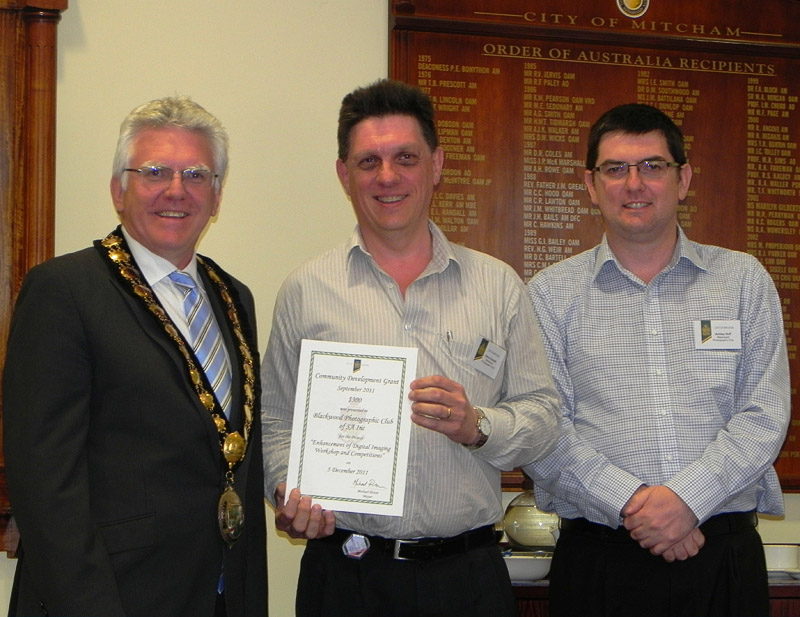
Chris Schultz and Ashley Hoff At the Mitcham Council Grants Reception
As the members of The Blackwood Photographic Club would know, in 2011, we received another grant from the Mitcham Council. This grant was used to purchase a Spyder Pro Monitor and Projector calibration device.
In Mid December, Chris and myself were invited to attend the official Community Development Grants Reception, which was held at the council chambers.
Our thanks and gratitude goes to the Council and the Grant Committee for accepting and approving our grant. We truly appreciate their continued support.
Ashley


 Blackwood Photographic Club of South Australia Inc.